

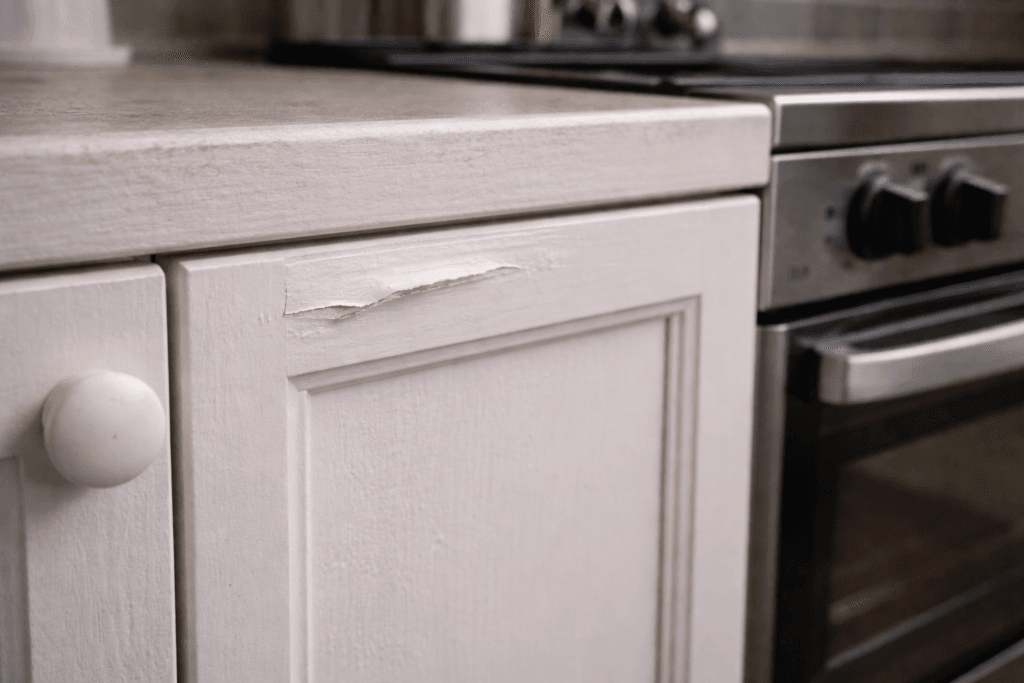
Cabinet refinishing failures in Florida homes usually begin with small prep mistakes that quickly worsen in high humidity.
Cabinet refinishing can be a smart way to refresh a kitchen without a full remodel. But in Florida homes, refinishing mistakes show up fast and often cost more to fix than doing the job correctly the first time.
High humidity, constant moisture, and temperature changes make Florida one of the most unforgiving environments for cabinets. When refinishing is rushed or done with the wrong materials, the finish does not just look bad. It fails.
This article explains what actually happens when cabinet refinishing is done incorrectly in Florida homes, the warning signs homeowners notice first, and why these problems rarely fix themselves.
Why Florida Exposes Refinishing Mistakes Quickly
Florida conditions magnify small errors.
Humidity allows moisture to move into tiny seams, joints, and edges of cabinets. Heat from cooking and daily use causes expansion and contraction. When cabinets are not properly prepared and sealed, these forces break down the finish from the inside out.
Techniques that may work in dry or cooler climates often fail in Florida kitchens within months.
Florida’s climate is also one of the main reasons kitchen cabinets tend to break down faster than homeowners expect.
The Most Common Cabinet Refinishing Failures in Florida
When cabinet refinishing fails, it is usually due to one or more of the following issues.
Poor Surface Preparation
Inadequate cleaning and sanding is the most common cause of failure.
Kitchen cabinets collect grease, oils, and residue over years of use. If these contaminants are not fully removed, primers and coatings cannot bond correctly.
The result is a finish that looks fine at first but begins to peel or bubble as moisture works underneath the surface.
Using the Wrong Products
Many failed refinishing jobs use products that are not designed for cabinets.
Standard wall paint and low quality coatings cannot handle:
- Frequent handling
- Heat from cooking
- High humidity environments
These products soften over time, wear unevenly, and break down much faster in Florida homes.
Skipping Moisture Resistant Primers and Sealers
Primers and sealers are not optional in Florida.
When moisture resistant products are skipped, humidity penetrates the cabinet material itself. This is especially damaging to MDF, particleboard, and older wood cabinets.
Once swelling or separation begins, surface repairs are no longer enough.
Improper Drying and Curing Conditions
Florida humidity dramatically affects drying and curing times.
Refinishing jobs often fail when:
- Coats are applied too quickly
- Cabinets cure in uncontrolled humidity
- Doors are reinstalled before finishes fully harden
This leads to soft finishes, imprint marks, and long term adhesion problems.
What Failed Cabinet Refinishing Looks Like
Homeowners usually notice problems gradually.
Common signs of failed cabinet refinishing include:
- Bubbling or blistering paint
- Peeling at corners and edges
- Sticky or soft cabinet surfaces
- Cloudy or uneven finish appearance
- Doors and drawers that no longer align properly
Once moisture gets beneath a failed finish, touch ups rarely last.
Why Fixing a Bad Refinishing Job Costs More
One of the most frustrating realities for homeowners is that fixing a bad refinishing job is often more expensive than doing it correctly the first time.
Correcting failed refinishing typically requires:
- Stripping or aggressive sanding
- Repairing damaged cabinet material
- Repriming and resealing from bare surfaces
- Recoating with proper cabinet grade finishes
In severe cases, cabinet damage becomes permanent and replacement may be the only option.
How Professional Cabinet Refinishing Prevents These Problems
Professional cabinet refinishing focuses on preparation and protection, not just appearance.
A proper refinishing process includes:
- Deep degreasing and cleaning
- Full sanding to neutralize existing finishes
- Repairing surface imperfections
- Applying professional grade primers
- Sealing with durable, moisture resistant coatings
This process creates a finish system designed to survive Florida humidity and daily kitchen use.
For homeowners who want long term durability, professional cabinet refinishing is often the difference between cabinets that last years and cabinets that fail quickly.
When Cabinets Can Still Be Saved
Even after a refinishing failure, cabinets can often be salvaged if damage is addressed early.
Refinishing is still a good option when:
- Cabinet boxes are structurally sound
- Damage is limited to surface finishes
- Moisture sources are corrected
- Proper materials and methods are used
Delaying repairs allows moisture damage to spread and limits available solutions.
Final Thoughts
Cabinet refinishing in Florida homes leaves very little room for error.
Shortcuts, rushed prep, and improper materials may look acceptable at first, but Florida conditions expose every weakness over time. When refinishing is done incorrectly, homeowners often end up paying to fix the same cabinets twice.
Understanding what goes wrong helps homeowners make informed decisions and avoid costly mistakes. With proper preparation and the right refinishing process, cabinets can hold up to Florida’s environment and maintain their appearance for years.