

By Southern Comfort Home Improvements | SoCoHome.net Serving Gainesville, Newberry, Alachua, High Springs, Ocala, Lake City, and Surrounding Areas
Every summer in Gainesville, homeowners ask the same questions: Why is my electric bill so high? Why can’t my AC keep up? Why are some rooms unbearably hot no matter what I do?
In most cases, the answer is sitting right above your head — in the attic.
Attic heat is one of the most overlooked and underestimated sources of home discomfort in North Central Florida. And unlike a broken appliance or a leaky pipe, it doesn’t announce itself with an obvious problem. It just quietly drives up your energy bills month after month while wearing your HVAC system down faster than it should.
The solution for most Gainesville homeowners comes down to two things: proper attic insulation and radiant barrier insulation. In this guide, we’ll explain exactly how each one works, why our local climate makes both especially important, and how together they can transform your home’s comfort and efficiency.
What Makes Gainesville Attics So Punishing
Before getting into solutions, it helps to understand why attic heat is such a significant problem here specifically.
Gainesville sits in North Central Florida — inland, away from any coastal breezes, and fully exposed to some of the most intense sunshine in the country. Our summers are long, our humidity is relentless, and our rooftops can reach temperatures of 160 to 190°F on a typical July afternoon. That extreme heat doesn’t just stay on the roof. It radiates downward into the attic, turning the space into what amounts to a giant oven sitting directly on top of your living area.
Making things worse, a large share of Gainesville’s housing stock was built in the 1970s, 1980s, and early 1990s — a period when building codes required far less insulation than we know is necessary today. Many of those homes have never had their attic insulation upgraded. If yours falls into that category, you’re likely spending significantly more on cooling than your neighbors in newer or better-insulated homes.
The result is an HVAC system that runs constantly, struggles to meet its set temperature, and wears out years sooner than it should. In most cases, the root cause isn’t the equipment — it’s the attic.
The Two Different Problems Your Attic Has
Here’s something that surprises many homeowners: heat enters your home through your attic in two fundamentally different ways — and they require two different solutions.
Conductive and convective heat transfer is when heat moves through solid materials and air. Hot attic air slowly bleeds its heat through your ceiling into your living space. This is what traditional insulation addresses.
Radiant heat transfer is when heat travels in straight lines as invisible infrared energy — the same way you feel warmth from the sun even on a cold day. Your roof absorbs this radiant energy from the sun, heats up to extreme temperatures, and then radiates that energy onto everything in your attic: the air, the ductwork, the attic floor. Traditional insulation does relatively little to stop this.
Understanding this distinction is key to understanding why both attic insulation and radiant barrier insulation are important — and why one without the other leaves a significant problem unsolved.
What Attic Insulation Does
Attic insulation — whether blown-in fiberglass, cellulose, or batt — works by slowing conductive heat transfer. It creates a thermal resistance between your scorching attic air and your living space below.
The effectiveness of insulation is measured by R-value: the higher the number, the greater the resistance to heat flow. For homes in Gainesville and throughout North Central Florida, the U.S. Department of Energy recommends attic insulation reach R-38 to R-60. In practice, that means somewhere between 12 and 20 inches of blown-in insulation, depending on the material.
A home with 4 inches of original fiberglass — common in houses built before 1990 — might have an R-value around R-11 or R-13. That’s less than a third of what’s recommended. Every degree of heat that slips through your ceiling because of inadequate insulation is energy your AC has to compensate for, hour after hour, day after day.
Blown-in insulation is the most practical and popular upgrade for existing Gainesville homes. It fills in around obstructions, covers joists evenly, and can be added on top of whatever insulation is already there. Most attics can be upgraded in a single day.
It’s worth noting that R-values are measured under controlled, moderate temperature conditions — around 75°F. When your attic hits 150°F, that insulation isn’t performing at its rated value. Which is exactly where a radiant barrier becomes essential.
What Radiant Barrier Insulation Does
A radiant barrier is a completely different technology designed for a completely different problem. Rather than slowing heat transfer, it reflects radiant heat away before it has a chance to heat up the attic in the first place.
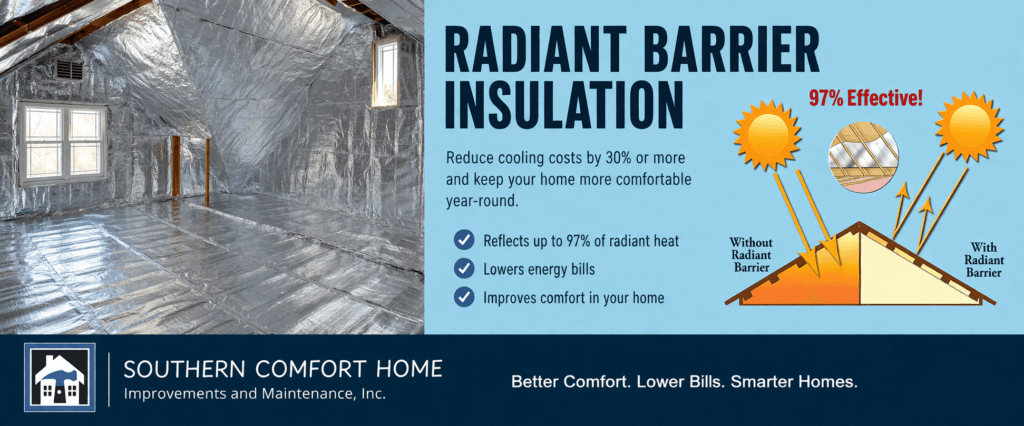
Radiant barriers are made of highly reflective material — typically aluminum foil bonded to a substrate — and installed on the underside of your roof rafters. When the sun heats your roof to 180°F and that hot surface begins radiating heat downward, the barrier reflects up to 97% of it back toward the roof rather than letting it flood your attic.
The practical result is significant: attic temperatures drop by 20 to 30 degrees Fahrenheit. That means cooler air surrounding your ductwork, less heat pressing through your ceiling, and an air conditioner that doesn’t have to fight as hard to do its job.
For Gainesville homes specifically, there’s an added reason this matters so much. The vast majority of homes in our area have their HVAC ducts running through the attic. Even well-sealed, well-insulated ducts lose efficiency when they’re surrounded by air that’s 150°F. A radiant barrier brings that ambient attic temperature down dramatically — and your whole system benefits.
You can learn more about how we install radiant barrier insulation and what the process looks like on our Radiant Barrier Insulation service page.
Why You Need Both — Not Just One
This is where a lot of homeowners get confused. If radiant barrier drops attic temperatures so effectively, why bother with insulation? And if you already have insulation, why add a radiant barrier?
The answer is that they solve different parts of the same problem.
A radiant barrier reduces the amount of radiant heat entering your attic from the roof — but it doesn’t prevent all heat transfer. Some heat still moves by conduction and convection. Without proper insulation beneath it, that remaining heat will still bleed into your living space.
On the other hand, insulation without a radiant barrier means your attic is still reaching extreme temperatures before the insulation even gets to work. And as temperatures climb, insulation becomes less effective — the R-value you’re counting on is calculated at moderate temperatures, not at the 140 to 150°F your attic is actually hitting on a summer afternoon.
Together, they cover the full picture: the radiant barrier keeps the attic significantly cooler, and the insulation handles whatever residual heat transfer remains. Homes with both consistently outperform homes with only one.
Warning Signs Your Attic Is the Problem
If any of the following sound familiar, your attic insulation and radiant barrier situation is worth a closer look:
Your electricity bills feel too high for the size of your home. If you’re spending significantly more than comparable homes nearby, your attic is a likely culprit.
Your AC runs almost constantly in summer. A properly insulated home shouldn’t require constant cooling. If your system never seems to catch up, it’s fighting heat from somewhere — and the attic is the most common source.
Certain rooms are always hotter than the rest of the house. Upper-floor rooms and spaces directly below the roofline are almost always first to suffer when attic insulation is inadequate.
You can feel warmth radiating from your ceiling. If your ceilings feel warm to the touch on a hot afternoon, heat is moving through them — which means your attic isn’t doing its job.
Your home was built before 1995 and has never had an insulation assessment. If this describes your home, there’s a very good chance your attic is underperforming by today’s standards.
Your HVAC system is aging faster than expected. Constant overwork shortens the lifespan of air conditioners significantly. If your system is being replaced more often than it should, attic heat may be the underlying cause.
The Air Sealing Step Most Contractors Skip
One thing worth knowing before you hire anyone for attic work: the single most important first step isn’t adding insulation — it’s sealing air leaks.
Gaps around recessed light fixtures, plumbing penetrations, attic hatches, and framing connections allow hot attic air to bypass your insulation entirely and flow directly into your living space. No amount of insulation layered on top of those gaps will fix the problem if the air is flowing freely around it.
A thorough contractor will seal these penetrations with spray foam or caulk before adding any new insulation. It’s a step that takes additional time, but it makes everything else significantly more effective. When you’re evaluating contractors, it’s worth asking specifically whether air sealing is part of their process.
What to Expect When You Work With SoCoHome
At Southern Comfort Home Improvements, we start every attic project with a thorough inspection — measuring your existing insulation, checking for ventilation issues, identifying air leaks, and assessing whether a radiant barrier is in place and properly installed.
From there, we’ll walk you through exactly what we find and what we recommend, without any pressure. Our goal is to make sure you understand what’s happening in your attic and what it would take to fix it, so you can make an informed decision.
We serve homeowners throughout the greater Gainesville area, including Newberry, Alachua, High Springs, Micanopy, Waldo, Hawthorne, Ocala, and Lake City. If you’re not sure whether we cover your neighborhood, reach out and we’ll let you know.
Ready to Find Out What’s Happening in Your Attic?
The first step is a free inspection and estimate. We’ll take a look at what you’re working with, tell you exactly what we find, and give you a clear picture of your options.
Learn more about our Radiant Barrier Insulation service →
Or call us directly at 352-318-4289 to schedule your visit.
Southern Comfort Home Improvements and Maintenance — Gainesville’s trusted home improvement team. We show up, we finish what we start, and we stand behind our work.